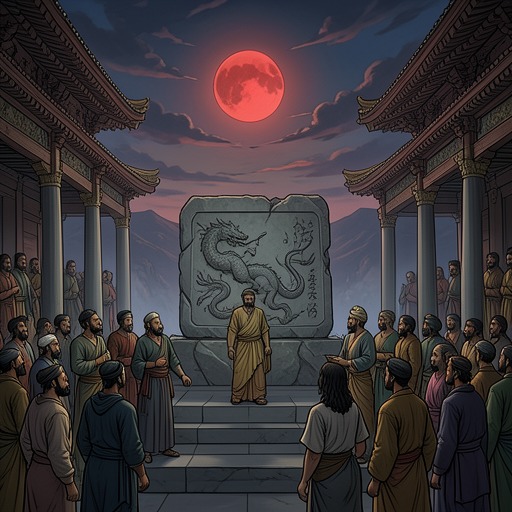
Liu Chen’s martyrdom
The Romance of the Three KingdomsLiu Chen’s martyrdom takes place as Shu Han faces defeat and surrender, and gives the kingdom’s fall a sharply personal ending: while the ruler yields to Wei, Liu Chen refuses to accept the transfer of his inheritance and dies in fidelity to Xuande. His wife and sons die with him, and the prince’s final act at Xuande’s shrine makes the collapse of a dynasty also a rupture within its ruling family.
The decision to surrender
After the fall of Mianzhu and the deaths of Zhuge Zhan and his son, news reaches Chengdu and the ruler of Shu Han. Panic spreads through the capital as people flee, fearing siege, conquest, and occupation. At the council, advisers propose flight south to take refuge among the Man tribes and later return to fight. Qiao Zhou opposes that plan, warning that the tribes cannot be trusted; he also rejects an alliance with Wu. He argues that surrender to Wei is the only practical course and may allow the ruler to retain a territory from which to serve the ancestral shrine and protect ordinary people.
The ruler cannot decide immediately. The following morning, Qiao Zhou submits a memorial supporting surrender, and the ruler accepts his recommendation. The decision is thus presented not as the consequence of a renewed military contest, but as a choice made after the loss of Mianzhu, the spread of panic, and the failure of proposed alternatives to persuade the council. For Liu Chen, however, what the ruler regards as a way to preserve some authority and protect the people is the abandonment of the dynasty’s patrimony.
Liu Chen’s refusal
The ruler has seven sons, but the account singles out Liu Chen as the only one with the spirit to oppose surrender. He turns on Qiao Zhou, calling him a coward for urging the ruler toward an unprecedented humiliation. The ruler rebukes Liu Chen as a shallow, warlike youth who would increase the bloodshed when everyone else agrees on submission.
Liu Chen answers that Jiang Wei remains capable of fighting his way through and argues that Shu should hold on. He denounces Qiao Zhou as a worthless fop and insists that the surrender decision must not be allowed to stand. The ruler answers that Liu Chen does not understand the Will of Heaven. Liu Chen then declares that he will not live to see his patrimony given away. The ruler refuses to reconsider and orders him expelled from the hall; he then has the surrender document prepared.
The envoys carry that document and the seal of authority to Deng Ai’s camp, are treated well, and return with news of the transaction. The ruler subsequently instructs Jiang Wei to surrender as well. This confirmation closes the remaining prospect of resistance in Liu Chen’s immediate world: the ruler has made the decision, the submission has been delivered, and the order has reached the kingdom’s commander.
A family’s shared resolve
Unable to bear the shame of surrender, Liu Chen returns to his palace with his sword. His wife, Lady Cui, asks what has happened. When he explains the decision and says that he will not bow to Wei, but will die so that he can face Xuande in the afterlife, she declares that she will do the same and asks permission to die first. Her choice makes the crisis an explicitly shared marital commitment rather than Liu Chen’s solitary response.
Liu Chen asks why she would follow him in death. Lady Cui’s answer rests on the duties of their relationship: he dies for his father, she for her husband, and both, she says, follow the same values. She dies before him. The narrative reports the manner of her death without developing it into a separate scene; what it emphasizes is her stated decision and the principle by which she understands it.
At Xuande’s shrine
After Lady Cui’s death, Liu Chen kills his three sons, takes his wife’s head, and goes to the temple of Xuande, the late emperor. There, kneeling and weeping, he offers the souls of his wife and sons and then his own before ending his life with his sword. His destination binds his protest against surrender to the memory of the founder whose lineage and rule the new order has displaced.
The sequence is starkly opposed to the ruler’s course. The ruler accepts surrender in the hope of preserving a place from which to protect the ancestral shrine and ordinary people; Liu Chen treats submission as a dishonor he cannot survive. His family’s deaths do not reverse the political decision: the document has already been sent, and the ruler has already instructed Jiang Wei to yield. Instead, the act registers the human and familial cost of the dynastic end through the one prince who refuses accommodation.
Loyalty and dynastic collapse
The account places Liu Chen’s defiance inside the larger fall of Shu Han, whose prospects have narrowed with the loss of Mianzhu and the deaths of Zhuge Zhan and his son. Qiao Zhou’s argument presents surrender as a means of limiting further damage, while Liu Chen’s appeal to Jiang Wei represents the remaining possibility of armed resistance. Their disagreement is therefore also a conflict over what loyalty requires when military defeat appears imminent: preservation of people and some continuing role for the ruler, or refusal to recognize the successor regime.
Liu Chen’s final destination gives that conflict its governing image. He does not die in battle or lead an effort to reverse the surrender; he goes to Xuande’s shrine after the decision has been made, bringing his family’s deaths there as an offering to the late emperor. The martyrdom cannot save Shu Han, but it preserves a last, uncompromising gesture of allegiance to its founding line as the political order itself passes away.